
Restoring a Flat Roof Membrane for Long-Term Performance in East Gwillimbury
A thorough membrane renewal addressing ponding, leaks and thermal movement on a residential flat roof.
- 1
Survey, moisture scanning and plan
We began with a full infrared and probe survey to map wet insulation and locate seam failures, then produced a restoration plan compliant with Ontario building code provisions for roof assemblies and vapour control. Moisture-tested areas were flagged for removal to ensure the finished membrane would be laid over sound substrate and adequate slope restored where feasible.
- 2
Selective removal and substrate preparation
Saturated insulation and failed EPDM seams were cut out and carefully removed to our staging area, keeping the rest of the roof assembly intact where possible. We replaced removed sections with closed-cell polyisocyanurate insulation (ISO) to meet thermal performance expectations, installed a new tapered insulation layer to improve drainage to the existing internal drains and ensured a level substrate for membrane application.
- 3
Membrane selection and installation
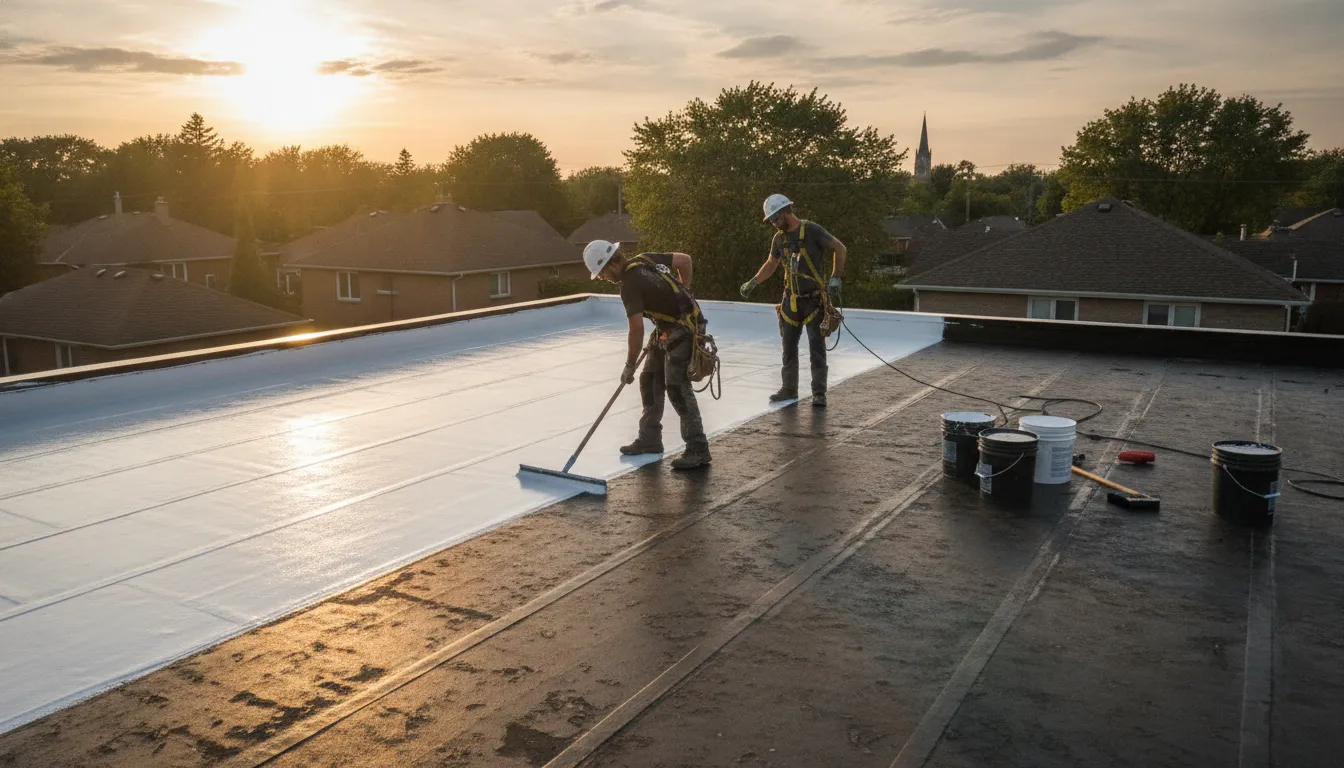
Given the homeowner’s longevity requirement, we specified a fully adhered 60-mil (1.5 mm) TPO single-ply membrane with reinforced scrim for dimensional stability and UV resistance. The membrane was hot-air welded at field seams, and all terminations received metal edge flashings with two-stage mechanical fastening and compatible sealants to prevent wind uplift and water entry.
- 4
Detailing drains, scuppers and parapets
We rebuilt internal drain assemblies with new clamping rings and stainless-steel strainers, ensured all scuppers had proper pitch and integrated flexible counterflashing at parapets. Flashing transitions were reinforced with uncovered TPO and welds tested with a seam probe to confirm continuity.
- 5
Quality control, finish and commissioning
Prior to handover we performed a flood test at low flow rates, seam-peen inspections and a final infrared sweep to check for entrapment and cold spots. The roof was documented with as-built notes, photos and maintenance recommendations; we reviewed these with the homeowners so they understood warranty coverage and seasonal inspection needs.
Frequently Asked Questions
How long does a membrane restoration like this typically take?
For a residential flat-roof restoration of this scale in East Gwillimbury we generally plan for a week to two weeks of on-site work depending on extent of removal and weather. Complex details or larger areas can extend the schedule, and we always build contingency for wet weather since the America/Toronto timezone sees variable spring and fall conditions.
Will the work be disruptive to the household and yard?
We aim to minimise disruption by using compact material handling, protective decking below work areas and discrete staging for materials. There is some noise during cutting and membrane welding, but we coordinate work hours and site access to respect neighbours in nearby Newmarket and Aurora.
How do I know when my flat roof needs restoration rather than replacement?
Restoration is appropriate when the substrate has limited localized moisture and the existing deck is structurally sound; widespread saturated insulation or structural decay will push the project toward full replacement. A moisture scan, probe inspection and review of seam conditions determine the right path.
What seasonal factors should East Gwillimbury homeowners consider?
Cold temperatures slow adhesives and make some membranes less pliable, so spring through early fall is ideal for leak-sensitive work. We also account for freeze–thaw cycles in material selection and ensure insulation and flashings are detailed for York Region’s climate to reduce movement-related failures.
Interested in a durable flat roof solution for your East Gwillimbury home?
Email us to discuss your roof condition, schedule a moisture survey, and receive a thoughtful, documented plan tailored to your property in East Gwillimbury and York Region.
Get a Free Quote